
Found, Cited, Shortlisted: AI Search and the Professional Services Business



Generative Engine Optimisation and why professional services firms need a different playbook. A white paper from Temple Brown, the Webflow agency based at Ketteringham Hall, just outside Norwich. It's a data-backed look at how AI is changing the way buyers find, shortlist and trust firms like yours, and what your marketing team can sensibly do about it. The whole thing is on this page. There's no form to fill in, no email gate, and you're welcome to save it as a PDF and pass it round the office.
TLDR
AI tools such as ChatGPT, Perplexity and Google's AI Overviews now answer a large share of the questions your prospective clients used to type into Google, and they don't simply repeat Google's rankings: only around a third of their answers overlap with traditional results. They name the firms whose expertise is clearly written down, independently backed up by press, directories, reviews and video, and technically readable by crawlers that can't run JavaScript. In the UK, roughly 30% of Google searches already show an AI Overview and ChatGPT drew 1.8 billion UK visits in eight months of 2025, according to Ofcom. Visitors who arrive from an AI recommendation convert at several times the usual rate, yet most of that influence never shows up as a trackable click. So the job has changed. Write down what makes your firm different, earn mentions in the places AI trusts, make sure your site can actually be read, and measure visibility and branded demand rather than clicks alone.
Executive summary
Search is going through a structural change, and it isn't a gentle one. Generative AI search isn't simply the next chapter of Search Engine Optimisation (SEO). It's a different system with different mechanics, different winners and a different way of keeping score. If your firm's website was built on the assumption that ranking well on Google is the whole job, that assumption is now only partly true, and the part that's no longer true is growing quickly.
We've written this paper because it's the conversation we keep having with marketing managers at law firms, accountancy practices, engineering consultancies and financial services businesses. They've invested properly in their website. Their rankings look healthy in the monthly report. And yet, when a prospective client opens ChatGPT or Perplexity and asks who the best commercial property lawyers in East Anglia are, or which accountants specialise in owner-managed businesses, their firm simply isn't mentioned. Nobody told them. No dashboard flagged it. Sound familiar?
In the pages that follow, we bring together third-party data from eMarketer, Otterly.AI, BrightEdge, Gartner, Adobe Analytics and CivicScience, along with UK figures from Ofcom and the Competition and Markets Authority, and the primary research published by John Morabito of Winston Digital Marketing, whose 2026 white paper on the same subject first prompted us to put our own view down in writing. We've layered all of that with what we see day to day as a Webflow agency that designs, builds and looks after websites for professional services firms, and that runs ongoing SEO and AI visibility retainers for clients across Norfolk, London and beyond.
The argument is a simple one. The firms, and frankly the agencies, that treat Generative Engine Optimisation (GEO) as "SEO with a new name" will quietly lose ground. Not overnight, and not dramatically, but steadily, in the shortlists that matter. The ones that understand where the two disciplines genuinely differ, and invest accordingly, will be the names that AI tools reach for when your next client asks for a recommendation. We'd rather you were in the second group, which is rather the point of writing this.
Part I. Two thirds of the answers are different
Why a good ranking no longer settles it
Ask most agencies whether being good at SEO makes you good at appearing in AI answers and you'll be told, kindly, not to worry. Google has said much the same in public. It's an understandable position, because it protects years of hard-won expertise and means nobody has to rethink their retainer. We'd quite like it to be true ourselves. Unfortunately, the evidence points the other way.
Research summarised by Winston Digital Marketing puts the overlap between conventional Google results and generative AI answers at about a third, 33%. So in roughly two searches out of three, the AI tool names a different set of firms from the ones sitting on page one of Google. If the two disciplines were really one and the same, you'd expect those lists to match almost perfectly. They don't come close.
The reason lies in how each system goes about finding things. A search engine returns a ranked list of pages. An AI tool writes an answer, and to do that it quietly splits your question into a handful of narrower searches, gathers results for each, then combines them using a method known as Reciprocal Rank Fusion, which favours whichever names surface most reliably across the whole set. Holding the top spot for one phrase doesn't buy you much if a rival appears in most of those background searches and you appear in only a couple. Google has long rewarded the single best page on a subject; AI tools reward the firm that keeps cropping up, credibly, wherever that subject is discussed.
Let's make that concrete. Imagine a prospective client in Norwich types "Which law firms in Norfolk are good for agricultural property disputes, and what should I expect to pay?" into ChatGPT. Behind the scenes, the tool might be searching for agricultural property solicitors in Norfolk, for farm tenancy dispute specialists, for fee guidance on property litigation, for reviews of regional firms, and for recent news about rural land cases. The firm that gets named is the one that shows up, credibly, across most of those threads. A firm with one beautifully optimised service page and nothing else to back it up will often lose to a firm that is mentioned in the Eastern Daily Press, listed in a legal directory, quoted in a farming trade publication and clear about its fees on its own site.
The wider industry data backs up the urgency. According to Otterly.AI's research, 50% of AI citations come from pages that are not in Google's top 10 rankings, so the link between Google position and AI visibility is far weaker than most marketers assume. Meanwhile, Gartner projects that organic search traffic will fall by 50% by 2028, while AI search use is growing by double digits month on month. This isn't a trend to keep half an eye on. It's a structural shift that's already well under way.
How quickly behaviour is moving
The scale of AI search adoption makes the stakes fairly plain. In the United States, eMarketer found that 66.6% of consumers now use social platforms for search purposes, which fragments discovery well beyond Google. The same research found that 25.9% of US internet users already use ChatGPT for search, which puts it ahead of Pinterest and close behind TikTok at 29.1%. Separately, eMarketer and CivicScience found that 54% of Gen Z consumers have used generative AI tools for product discovery. Adobe Analytics reported that AI-driven traffic to retail brand websites rose by 1,200% year on year in February 2025, and Adobe's 2025 survey found that more than 80% of consumers trust generative AI recommendations as much as, or more than, organic and paid search results.
The UK picture is heading the same way, perhaps more quickly than many boardrooms realise. Ofcom's Online Nation 2025 report found that Google Search is used by 82% of UK adults and handles around 3 billion searches a month, but that roughly 30% of those searches now show AI Overviews, and 53% of adults say they see these summaries often, usually without having gone looking for them. ChatGPT had 1.8 billion UK visits in the first eight months of 2025, up from 368 million in the same period of 2024. That's not a niche behaviour any more. That's your clients, at their desks, between meetings.
There's one figure we'd underline twice. Otterly.AI found that visitors referred by AI search convert at three to five times the rate of traditional search visitors. That makes sense when you think about it: by the time someone clicks through from an AI recommendation, a fair amount of the comparing and checking has already happened on their behalf, so they arrive further along and better disposed. For a professional services firm, where the sales cycle runs on trust and a single client can be worth a great deal over the years, that shorter and warmer route in deserves serious attention.
Part II. Three reasons a good firm goes unmentioned
What our health checks keep finding
When we run a website health check, which is how every one of our retainers starts, including for sites we built ourselves, the AI visibility problems we find almost always fall into one of three categories. Winston Digital Marketing describes the same three gaps in its own audit work, and the pattern holds whether the site belongs to a London law firm or a family-run business in a Norfolk market town. It's worth understanding them separately, because each one needs a completely different fix.
The missing facts: your differentiators aren't written down
It's the least glamorous of the three, and the one we see most. Winston Digital Marketing describes auditing a US dispensary that offered a discount for military veterans, a real point of difference in its market, yet never appeared when people asked ChatGPT for exactly that. The discount wasn't mentioned anywhere on the website, so there was nothing for the AI to find.
We see the professional services version of this every month. An accountancy practice that specialises in farming clients but describes itself on its home page as offering "a full range of accountancy services". A law firm with three partners who are accredited specialists in a particular area of practice, but the accreditations live in a PDF brochure nobody can search. An engineering consultancy that works almost exclusively on listed buildings and heritage projects, yet never actually says so in plain words. In each case, the firm knows exactly what makes it different. It just hasn't written it down where the machines can read it.
The first fix, then, is often refreshingly ordinary: write down the facts. Every accreditation, sector specialism, fee arrangement and service you'd mention in a pitch meeting should appear as plain, readable text on your site, ideally on a page that's clearly about that subject. The B2B data shows how far this can go. eMarketer reported that ERI, a firm specialising in IT asset disposition, ranks first for "ITAD services" across AI platforms, largely because it has published more than 2,500 pages on its particular area of expertise. Nobody's suggesting a regional practice needs 2,500 pages. The principle still applies, though: thoroughness reads as authority, and a thin website rarely does.
The missing witnesses: nobody else is vouching for you
AI tools behave a little like a cautious client taking up references. They want to hear about you from someone other than you: the trade press, review platforms, directories, YouTube, LinkedIn, forums and Wikipedia. A firm that describes itself as the region's leading employment team, with nothing elsewhere to support the claim, gives the tool very little to go on.
Otterly.AI's citation research puts a number on this. Some 95% of AI citations come from third-party websites, including media outlets, blogs and YouTube, and 25% of all website citations in AI answers come specifically from news and media sources. In other words, brand building now matters more than link building. For a law firm, that might mean the legal directories, local and trade press, and the commentary a partner gives to a journalist. For an accountancy practice, it might be a column in a regional business publication, a well-maintained Google Business Profile and a steady flow of genuine reviews. For an engineering consultancy, it's the trade body membership pages, case studies published by clients and partners, and talks given at industry events.
That's the real departure from the SEO most of us learned. Links still have their place, but the thing being weighed now is reputation: how often, and how credibly, other people talk about you, across how many different places and formats.
The locked door: crawlers can't read what you've published
There's a slightly awkward bit of history here. A decade or so ago, the standard advice to anyone building a website was to keep important content out of JavaScript so search engines could read it. Then Google became very good at rendering scripts, the warnings faded, and a great many sites were rebuilt on frameworks that assemble the page inside the visitor's browser, complete with review widgets and content pulled in from elsewhere.
The crawlers behind tools such as ChatGPT, Claude and Perplexity are, broadly speaking, back where Google was in 2010. They generally read only the HTML your server sends in its first response and don't run scripts, so anything that appears only once JavaScript has executed may as well not be there: review carousels, filtered service listings, FAQ accordions populated by code. Some organisations have gone a step further and blocked AI crawlers outright in robots.txt, often for perfectly sensible reasons to do with how their content is used, without realising they've also taken themselves out of the running for AI recommendations.
Otterly.AI's technical analysis lists the usual culprits: CDN settings that block AI bots, robots.txt files that disallow AI crawlers, and JavaScript-heavy front ends that AI systems simply can't parse. Its recommendations line up with what we see in practice: static or pre-rendered pages, structured data markup, clean heading structure and text-based content that an AI agent can read without running any code.
This is one of the quieter reasons we build on Webflow. Published Webflow pages are served as pre-rendered HTML, so your headings, body copy and CMS content are present in that first response for every crawler to read. It isn't a magic shield, mind. Content dropped in through custom code embeds, third-party review widgets or script-driven sliders can still fall through the gap, and part of every health check we run is comparing what a person sees in the browser with what a crawler actually receives. More often than not, that comparison is where the most useful findings turn up.
Part III. Who the AI is really listening to
Recommendations are less independent than they look
There's a comfortable belief taking hold that an AI recommendation is somehow more neutral than a page of search results. The machine weighed everything up, the thinking goes, so whoever it names must be the best choice. It's a nice idea. It's also not quite how it works.
In an ideal world, asking ChatGPT for the best moisturiser for dry skin, or the best payroll software for a small practice, would send it off to read hundreds of reviews, specifications and expert opinions before reaching a considered view. In practice, as Winston Digital Marketing's research shows, the tools tend to take a shortcut. They search for existing "best of" round-ups, read the articles that rank well, and lean heavily on whatever those articles already recommend. If a product sits at the top of a well-ranked roundup in a national magazine, there's a good chance it'll sit near the top of the AI's answer too. Not because the tool independently decided it was better, but because it read the same list you could have found yourself.
That matters, because a fair number of those lists aren't purely editorial. In consumer sectors, Winston notes that some major publications treat roundup placements as part of their commercial offer, sometimes bundled with a substantial advertising spend, sometimes sold directly, and that affiliate commission arrangements give publishers a reason to favour products that pay well. So a recommendation can pass through several commercial hands before it reaches the person reading the AI's answer, and none of that context travels with it.
The professional services version
You might reasonably think this is a problem for skincare brands and software companies rather than for a law firm in Norwich or an accountancy practice in Cambridge. It's closer to home than it looks. Search for "best commercial solicitors in Norfolk" or "top accountants for small businesses in East Anglia" and you'll find a steady supply of directory-style round-ups, some carefully researched, some produced by companies that charge to be listed, and some that appear to have been written with very little research at all. Award schemes with entry fees, sponsored rankings and "top ten" pages on lead-generation sites all feed the same pool of material that AI tools draw from.
There's also outright manipulation going on. Winston's paper describes companies publishing hundreds of near-identical AI-generated articles along the lines of "Top providers of [service] in [place]", each one conveniently listing the publisher first. Enough of those pages, ranking well enough, can push a firm into AI answers for categories where it has no real track record. Because Reciprocal Rank Fusion rewards consistency of appearance across lots of searches, flooding those searches works, at least for a while.
What we'd actually do about it
The reassuring part is that search platforms have a long record of catching up with this sort of thing. Google's September 2024 update, for instance, hit a number of businesses that had built their visibility on mass-produced, low-value content. The less reassuring part is that catching up takes time, and in the meantime Winston points out that GEO has no equivalent of the link penalties that made buying links such a risky business in traditional SEO. For now, firms that invest in legitimate media partnerships, sponsored content that's properly labelled, and inclusion in respected directories are seeing outsized returns.
Our advice to clients is to separate the two clearly. Being listed in the directories your sector genuinely respects, entering awards that mean something to your clients, and building real relationships with trade and regional journalists are all sensible, durable investments, and they happen to be exactly what AI tools read. Paying for a spot on a page that exists only to sell spots, or publishing a hundred thin "best firms" articles with yourself at number one, might work this quarter. We wouldn't bet a firm's reputation on it lasting. For a regulated profession, where credibility is the whole product, the slow and honest route is also the safe one. Substantiated claims, real reviews from real clients, recognised accreditations and expert commentary will hold up through whatever the next algorithm change brings. Shortcuts rarely do.
Part IV. Video, the channel most firms overlook
What the citation data keeps saying
Ask a room of marketing managers at professional services firms where AI tools get their information and you'll hear about websites, news articles, directories and perhaps Reddit. Video rarely comes up. It should. When Winston Digital Marketing analysed the sources cited in AI answers for a large beauty brand across hundreds of prompts, YouTube came out as the second biggest source of citations, ahead of Reddit, niche blogs and trade publications. Across Google's AI Overviews more generally, YouTube is regularly the single most cited source, comfortably ahead of Reddit.
Otterly.AI's research points the same way. YouTube and LinkedIn are among the most cited social platforms in AI answers, and the detail is telling: 94% of AI citations of YouTube go to long-form videos rather than Shorts, with Perplexity and Google responsible for most of that citation volume. Yet when we look at the GEO plans other agencies put in front of clients, video is usually an afterthought, if it appears at all. For B2B and professional services in particular, that's a gap worth exploiting.
Discovery happens before the prompt
There's a subtlety that's easy to miss. By the time someone asks an AI tool to compare firms, they usually already have one or two names in mind. Those names got there somehow, and for a growing share of people, "somehow" means video and social platforms. In the US, eMarketer found that 49.1% of consumers use YouTube for search and 29.1% use TikTok, that 40% of TikTok users search on the platform several times a day, that 73% of TikTok searchers do so daily, and that 58.8% of Gen Z use TikTok for search, making it their main discovery platform. eMarketer's wider research describes social search as a full-funnel behaviour, used for discovery, research, comparison and purchase, and TikTok has even introduced keyword bidding for search ads. Closer to home, Ofcom's Online Nation 2025 report found that YouTube is used by 94% of UK adults, for an average of 51 minutes a day, before you even count viewing on the television.
None of this means a firm of chartered surveyors needs to start dancing on TikTok, and we'd politely talk you out of it. What it does mean is that when an AI tool lists your firm among five options, whether that mention turns into an enquiry depends a great deal on whether the reader has come across you before. If they've watched one of your partners explain the new building safety rules in a clear, unhurried ten-minute video, or seen your head of tax walk through a budget announcement on LinkedIn, your name in that AI answer lands rather differently. It feels familiar. Familiar is trusted.
That's why we think of GEO as part of how a firm takes itself to market, not as a search tactic bolted on at the end. The firms doing well in AI answers are usually the ones that have already done the work of being recognised.
From video views to people searching for your name
Winston's own measurement work gives a useful sense of how this plays out. For a holiday rental client, it found a 58% correlation between TikTok views and Google searches for the brand's name, with a consistent seven-day lag. The lag will vary by sector. Choosing a solicitor for a contested probate case involves rather more deliberation than booking a cottage on the north Norfolk coast. But the mechanism is the same everywhere: people see you in video, you join their mental shortlist, and a little while later they go looking for you by name. We'll come back to why that matters for measurement in Part V.
What a sensible video approach looks like for a firm
Start with the questions. The prompts and searches you'd like to be visible for are, very often, ready-made video titles. If clients are asking how to challenge a commercial rent review, or whether they need an R&D tax claim specialist, that's a video as much as an article. Treat transcripts, titles, descriptions and chapters with the same care you'd give a service page, because that text is what AI tools actually read when they cite a video.
Then make each piece of filming work harder. One well-planned recording session can produce a long-form YouTube video for AI citation, a few shorter cuts for LinkedIn, and an embedded version on the relevant page of your website, which enriches the page itself. We build our Webflow sites so that a marketing team can drop a video and its transcript onto a page without waiting for a developer, which sounds minor until you realise how often content stalls for exactly that reason.
Finally, favour expertise over polish. The videos that do best, both with platform algorithms and with AI tools, tend to be the authentic ones: a genuine expert sharing something genuinely useful, filmed decently but not lavishly. Your partners and senior staff know things that would take a competitor years to learn. Ninety seconds of that, recorded in a meeting room at lunchtime, is worth far more than a glossy brand film that says nothing in particular.
Part V. Measuring what you can't click on
Why the usual reports fall short
This is the part of the conversation that tends to make finance directors shift in their seats, and honestly, fair enough. For twenty years, digital marketing has run on a tidy assumption: every impression should lead to a trackable click, and every click should lead to revenue you can attribute. AI search doesn't play along with that.
When ChatGPT names your firm as one of five worth considering, the person reading may never visit your website at all. The value sat in being mentioned, in being part of the shortlist, endorsed by a tool they've come to trust. That's the "zero-click" pattern that has been creeping into ordinary search for years, and generative search has sped it up considerably. Even when a click does happen, the trail is often muddy. Traffic from Google's AI Overviews tends to appear in analytics as "direct", indistinguishable from someone typing your address into their browser. There's no tidy referrer, no campaign tag, nothing that says "this visitor saw you in an AI answer first".
So if your reporting only counts what can be clicked and attributed, GEO will always look as though it's producing nothing. That conclusion would be wrong, and acting on it would be expensive.
A different set of numbers
Otterly.AI offers a helpful way to picture the AI search funnel. At the top sits brand coverage, meaning whether you appear in AI answers at all. Below that come citations of your website specifically, then referral traffic (both people clicking through and AI bots visiting), then branded and direct traffic as the indirect signal, and finally conversions. Its reporting tracks this across ChatGPT, Google's AI Overviews and AI Mode, Gemini, Copilot and Perplexity, using measures such as the share of relevant prompts in which your brand appears, how often your own domain is cited, the gap between you and the market leader, month-on-month growth in coverage, and which third-party sources are driving your mentions.
The important shift is in what's being measured. As Otterly.AI frames it, SEO reporting was built around impressions, clicks, traffic and conversions, which is essentially transactional. AI search reporting is built around visibility and citation, which is essentially reputational. For professional services firms, reputation was always the real asset anyway. It's rather nice to finally have a way of tracking it.
Branded demand as the proof
If prompt visibility is the early signal, growth in people searching for your firm by name is the later evidence that it's working. The mechanism is the same one described in Part IV. When prospective clients repeatedly see your firm recommended in AI answers for questions that matter to them, the name becomes familiar, and familiarity shows up as more branded searches on Google, more direct visits, and in time more enquiries.
In practice, that gives you a two-layer approach. Track visibility across a defined set of prompts each month as your leading indicator. Track branded search volume, branded and direct traffic, and enquiry levels as your lagging indicators. Then look at how the two move together over time. There's nothing exotic about this. It's how sensible firms have always judged the activity that doesn't come with a tracking link.
Think about the partner who speaks at every Norfolk Chamber event, or the practice whose name is on the boards at Carrow Road. Nobody can tell you which handshake or which advertising board produced which client instruction, and nobody seriously argues those things are worthless as a result. Firms judge them by whether, over a year or two, they're better known and busier. GEO deserves the same grown-up treatment, backed by the best measurement tools available rather than abandoned for lack of a last-click report.
The return of correlation
Before last-click attribution took over, marketing was largely measured through correlation and incrementality: studying aggregate patterns across large audiences, linking investment to outcomes, and using statistics to estimate impact. AI is now making that kind of analysis far more accessible. Media mix modelling, multi-touch attribution and correlation studies that once needed a dedicated data science team can increasingly be run by an in-house marketing team with the right tools and a bit of help.
The firms that measure GEO well will combine both approaches: precise prompt-level tracking for week-to-week decisions, and correlation with branded demand for the bigger budget questions. It isn't one or the other. We report to retainer clients in exactly this layered way, because a single ranking chart no longer tells the whole story, and pretending otherwise doesn't help anyone plan.
Part VI. Expertise is the only content left worth writing
The end of the explainer article
For the best part of a decade, professional services websites have filled up with what we'd politely call introductory content. "What is a lasting power of attorney?" "Do I need to register for VAT?" "What does a structural engineer do?" Useful enough, written in the firm's voice, optimised for search, and almost entirely interchangeable with the same article on forty other firms' sites.
That sort of content is now being automated at speed, and more to the point, anyone can get a perfectly decent answer to those questions straight from ChatGPT without visiting your site at all. If every firm has the same explainer, and the AI can produce it on demand, the explainer stops being an advantage. It becomes the minimum.
The opportunity is in what that frees up. If the routine material can be drafted far more quickly, your experts' limited time can go on the things nobody else can write. Rather than a senior associate spending half an hour correcting a dull introductory article, imagine her spending that half hour talking through the most unusual case she's handled this year, the mistake she sees clients make again and again, or the change in the rules that most firms haven't spotted yet. That conversation, recorded and then shaped with care, becomes content that genuinely adds something new. The industry has a name for this, information gain, and it's what both search engines and AI tools increasingly reward.
The B2B data suggests most teams already feel the pressure. eMarketer found that 21% of B2B marketers name creating high-quality content as their single biggest SEO challenge, while 49% call content marketing their top priority. The difficulty isn't producing more. It's producing something that matters. Otterly.AI's guidance on what AI systems favour reads like a description of good professional writing anyway: lead with the answer, offer original frameworks and named concepts, use real examples rather than generic advice, and back opinions with reasoning.
We've seen this play out on our own projects. Website builds very rarely stall on design or development. They stall on copy, usually because the people who know the most are the people with the least time to write. The fix we've found works best is to stop asking partners to write and start asking them to talk, for thirty minutes, with someone who knows which questions to ask. The resulting copy is better, it arrives sooner, and it's full of exactly the kind of first-hand detail that AI tools can't find anywhere else. Your experts are your advantage. Start recording them.
Building authority away from your own site
Since the overwhelming majority of AI citations come from third-party sources, the work of building authority can't stop at your own domain. Otterly.AI's citation research helps to map where the effort is best spent.
Public relations and earned media come first. A quarter of all website citations in AI answers come from news and media sources, and listicles, press releases and editorial coverage all perform well. Press releases tend to be cited most when the headline speaks to a question people actually ask, the release includes concrete data or milestones, and it carries some element of independent review or endorsement. For a regional firm, that might mean publishing the findings of a client survey, commenting on a change in legislation within hours rather than weeks, or giving a local business editor a story with real numbers in it.
Reddit is among the most cited domains across AI platforms, and BrightEdge's April 2025 analysis, reported by eMarketer, found that Reddit's visibility in AI Overviews rose by 1,000%. That's not a licence to start posting promotional comments, which will backfire. It does mean that genuine, transparent participation in relevant communities, with people clear about who they work for and offering helpful answers, builds a footprint that AI systems actively draw on. The same principle applies to the professional forums and LinkedIn groups where your clients already talk to each other.
Wikipedia is among the most cited domains in most countries across AI platforms. A page about your organisation strengthens both authority and what's known as entity clarity, meaning the AI's understanding of exactly who you are, and inclusion in relevant category pages adds further weight. Wikipedia's notability rules are strict and rightly so, so this route suits firms with a genuine public profile and a record of independent coverage. For those that qualify, it's one of the most valuable GEO investments available.
YouTube and LinkedIn round things off, as Part IV explained. Long-form YouTube video accounts for 94% of the AI citations that come from YouTube, and LinkedIn articles and posts are a written format AI systems cite regularly. For many professional services firms, LinkedIn is already where the partners are most active. It's simply a question of turning that activity into something substantial enough to be cited.
Part VII. Why smaller firms have a genuine opening
A less crowded front row
After several parts that may have read like a list of new problems, here's some properly good news, particularly for regional and mid-sized firms competing against national names with very deep pockets.
Google's traditional rankings lean heavily on authority built up over years, through PageRank and the backlinks that feed it. For most competitive terms, a firm without a national profile and a decade of link building simply isn't going to break into the top ten. Many excellent regional practices have quietly accepted that, and focused on referrals and local reputation instead.
AI search is less rigid. Because these tools don't simply lift Google's top results, and because they weigh how thoroughly a question is answered and how well a claim is corroborated alongside raw authority, smaller and newer firms can appear alongside much larger ones. The tool doesn't much mind how long you've been trading or how many links point at your home page. If your content answers the question directly, your claims are backed up elsewhere, and your site is technically readable, you're genuinely in contention.
Specific questions favour specialists
The real advantage lies in how specific people's prompts are becoming. Nobody types three words into ChatGPT. They write things like "I run two holiday lets in north Norfolk and I'm worried about the changes to furnished holiday let tax rules, which local accountants actually understand this?" or "We're a 40-person engineering firm in Cambridge looking for an employment lawyer who's dealt with TUPE on a small acquisition." The AI tailors its search to that level of detail in a way a traditional results page never could.
A national firm with a generic page on tax planning might not be the best answer to either question. A regional practice that has clearly written about holiday let taxation, has a partner quoted on it in the local press, and has reviews from holiday let owners, very well might be. Specialism, clearly expressed, beats size.
The consumer data shows how readily people now accept recommendations from smaller, direct sellers. In the US, eMarketer reports that direct-to-consumer ecommerce reached $239.75 billion in 2025, 19.2% of all US ecommerce, and that Gen Z are twice as likely as the wider population to buy direct from brands (28% against 13%). Gen Z are also the group most likely to discover brands through AI and social search. eMarketer found too that a brand's own website remains the most trusted source of pre-purchase information in several categories, cited by 52% for consumer electronics and 47% for clothing, while Adobe's 2025 research found that 55% of consumers use generative AI for product research and 47% for recommendations. Those are retail figures, but the direction of travel is the same for services. People are increasingly comfortable letting an AI tool point them towards a name they hadn't heard of, provided the evidence stacks up.
That's precisely the kind of client we tend to work with: established, well-run firms with real expertise and a strong local reputation, whose websites haven't yet caught up with how good they actually are. For firms like that, AI search is less a threat than an invitation into rooms they used to find closed.
Part VIII. What this means for agencies, ourselves included
Optimism isn't a strategy
Marketers are broadly upbeat about all this. eMarketer's 2025 B2B SEO research found that 85% of marketers expect AI to have a positive effect on SEO, and 63% see AI Overviews as a positive development. Believing something will help and knowing how to make it help are, of course, two quite different things. The same research found that only 11% of B2B marketers rank SEO as a current investment priority. That isn't because search has stopped mattering. It's because the industry hasn't yet explained GEO clearly enough for anyone to budget for it with confidence. Which, if you're an agency prepared to do the explaining properly, is a considerable opportunity, and if you're a client, is a reason to ask your agency some pointed questions.
How the work itself is changing
Otterly.AI describes the change in agency work as a move across five dimensions. We've summarised it below in our own terms.
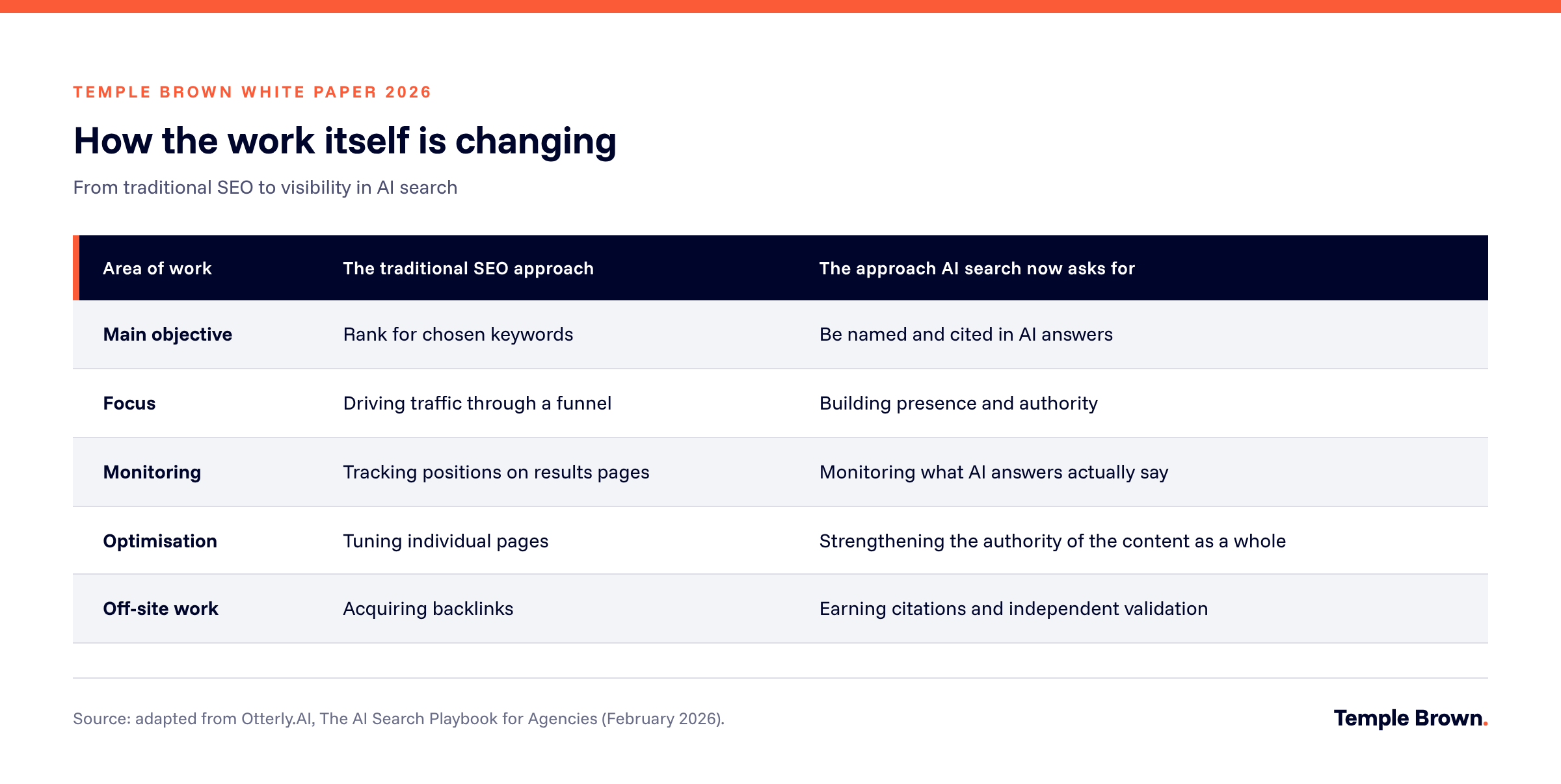
This isn't a rebrand with a new acronym on the invoice. It's a genuine widening of the skills involved. GEO sits where technical SEO, content strategy, digital PR, social search and brand marketing overlap, and no single traditional discipline covers all of it. That's one reason we've deliberately kept strategy, design, development and SEO within one team at Temple Brown. When the person tuning your search visibility can walk across the room at Ketteringham Hall and ask the developer why a page isn't rendering its FAQ content in the raw HTML, things get fixed in an afternoon rather than drifting across three suppliers and a month of emails. Where clients need specialist paid search, we work with trusted partners matched to their sector and scale rather than pretending to do everything ourselves, and we'd encourage any firm to be wary of an agency that claims it does.
B2B is where the quick wins are hiding
The eMarketer data highlights something many agencies are missing: some of the most striking early GEO results are coming from B2B businesses, not consumer brands. One B2B services company optimised 52 FAQ pages for AI visibility, and 32 of them now appear in AI Overviews, a success rate of 61.5% that would be remarkable by the standards of traditional SEO. Meanwhile, BrightEdge's April 2025 figures show that visibility in AI Overviews rose by 281% for YouTube, 196% for LinkedIn and 1,000% for Reddit, which are exactly the platforms where B2B and professional content naturally lives.
For law firms, accountancy practices, engineering consultancies and financial services businesses, the implication is fairly direct. A well-structured, honest, properly marked-up FAQ resource on your own site, written by people who actually know the answers, is one of the most efficient GEO investments you can make. It's also where we usually suggest clients start, once a health check has confirmed that the technical foundations will let AI crawlers read it.
Part IX. A practical first 90 days
Month one: find out where you stand
Resist the urge to start writing. The most useful first step is to measure. Agree, with the partners or directors who bring in work, the twenty or so questions a serious prospective client might ask an AI tool before choosing a firm like yours. Some will be broad ("best employment solicitors in Norfolk"), others very specific ("accountant in Norwich who understands farm diversification and inheritance tax"). Put those questions to ChatGPT, Perplexity, Gemini and Google's AI Overviews, and note three things each time: whether your firm is named, which competitors are named instead, and which sources the tool cites to justify its answer.
At the same time, run a technical check of your own site. Compare what a visitor sees in their browser with the raw HTML a crawler receives, page by page for your key services. Check your robots.txt and any content delivery network settings for rules that block AI crawlers. Make sure your structured data, especially for your organisation, people, services and FAQs, is present in that first response rather than injected later by a script. On a Webflow site this is usually in good shape, give or take a few embeds. On older platforms heavy with plugins, it's often where the biggest surprises turn up.
Month two: fix the foundations
By now you'll know whether your gap is mostly on your own site, mostly off it, or both. If it's on-site, the work is about writing down the facts: a clear page for each genuine specialism, accreditations and sector experience stated in plain text, fees explained as openly as your profession allows, and an FAQ resource answering real client questions in a direct, answer-first style. If it's off-site, look closely at the sources the AI tools cited for your competitors, because those are the publications, directories and platforms that carry weight in your sector, and they're where your effort should go. Most firms find it's a bit of both, which is entirely normal.
This is also the moment to appoint an owner. AI visibility tends to fall between marketing, business development and whoever looks after the website, which in practice means nobody looks after it. One named person, reporting on it monthly alongside the usual search figures, makes a noticeable difference.
Month three: build the habit
GEO isn't a one-off project, any more than reputation is. The third month is about setting up a rhythm you can keep: a short recording session with one expert each month, turned into an article, a long-form video and a handful of LinkedIn posts; a standing relationship with two or three journalists who cover your sector or region; a steady process for asking satisfied clients for reviews; and the same set of prompts re-checked every month so you can see whether the needle is moving. Pair that with branded search and enquiry data, and within a couple of quarters you'll have a far clearer picture than any ranking report ever gave you.
A note on control, and on UK regulation
Some firms, understandably, would rather their content wasn't used by AI at all. It's worth knowing that the rules here are shifting in the UK. In October 2025 the Competition and Markets Authority designated Google as having strategic market status in general search, with AI Overviews and AI Mode within scope. In June 2026 the CMA went further, imposing a conduct requirement that, in what it describes as a world first, will give publishers effective tools to stop their content being used to power AI features in Google search, and requires Google to attribute publisher content with clear links in AI-generated results. Google has nine months to implement the changes, and the CMA's case page on Google's search services tracks progress.
That's welcome for publishers whose business is selling content. For most professional services firms, though, being cited is the whole point, and opting out would mean stepping away from the very answers your clients are reading. Our view is that it's a decision for each firm to take deliberately, with its eyes open, rather than one to stumble into via a cautious line in a robots.txt file that nobody remembers adding.
Conclusion and next steps
Visibility is now a reputation question
GEO isn't SEO wearing a new badge, and it isn't something an existing SEO supplier can simply absorb without new thinking, new tools and a new way of measuring. It sits where technical SEO, content, PR, social search and brand marketing meet. For professional services firms, that's actually rather familiar territory, because it describes how good firms have always won work: by being genuinely expert, saying so clearly, and having other people confirm it.
The evidence is hard to argue with. Around two thirds of AI answers differ from Google's results. Half of AI citations come from pages outside Google's top ten. Some 95% of citations come from third-party sources rather than a firm's own site. More than half of Gen Z have used generative AI to discover products, AI-driven traffic to retail brands grew twelvefold in a single year, over 80% of consumers trust AI recommendations at least as much as traditional search, and visitors referred by AI convert at three to five times the usual rate. In the UK, Ofcom's figures show AI summaries are already part of everyday searching for most adults, whether they asked for them or not.
The firms that do well over the next few years will treat AI visibility as part of how they take themselves to market, wherever the search box happens to be. The ones that file it under "just SEO" may find, a little further down the line, that they've been left off shortlists they never knew existed.
Taking this to your marketing team
The gap between a healthy ranking report and genuine AI visibility tends to stay hidden longest in established firms, precisely because the existing numbers look fine. You can hold strong Google positions for years and still be absent from the answer a client receives from ChatGPT or Perplexity. Nothing in a standard dashboard will tell you.
If you're raising this with partners or a leadership team, three questions usually get the conversation moving faster than any statistic. Which of the questions our clients ask before instructing a firm are being answered by AI tools, and are we named in those answers? When a competitor is named instead, which outside sources are the tools relying on to justify it? And who in the firm is responsible for AI visibility today, and what do they report?
That's exactly what our website health check is designed to answer. We'll look at how AI tools treat your sector and region, which sources they lean on, whether crawlers can read your site properly, and where your pages are giving them nothing specific to cite. Your team keeps the findings, whether or not we work together afterwards. If it's useful, we'll talk it through on a short call, or over coffee at Ketteringham Hall if you're nearby. We work alongside in-house marketing teams rather than replacing them, and we'd rather give you an honest picture than a sales pitch.
Request your free website health check and find out whether AI tools are recommending your firm, or someone else's.
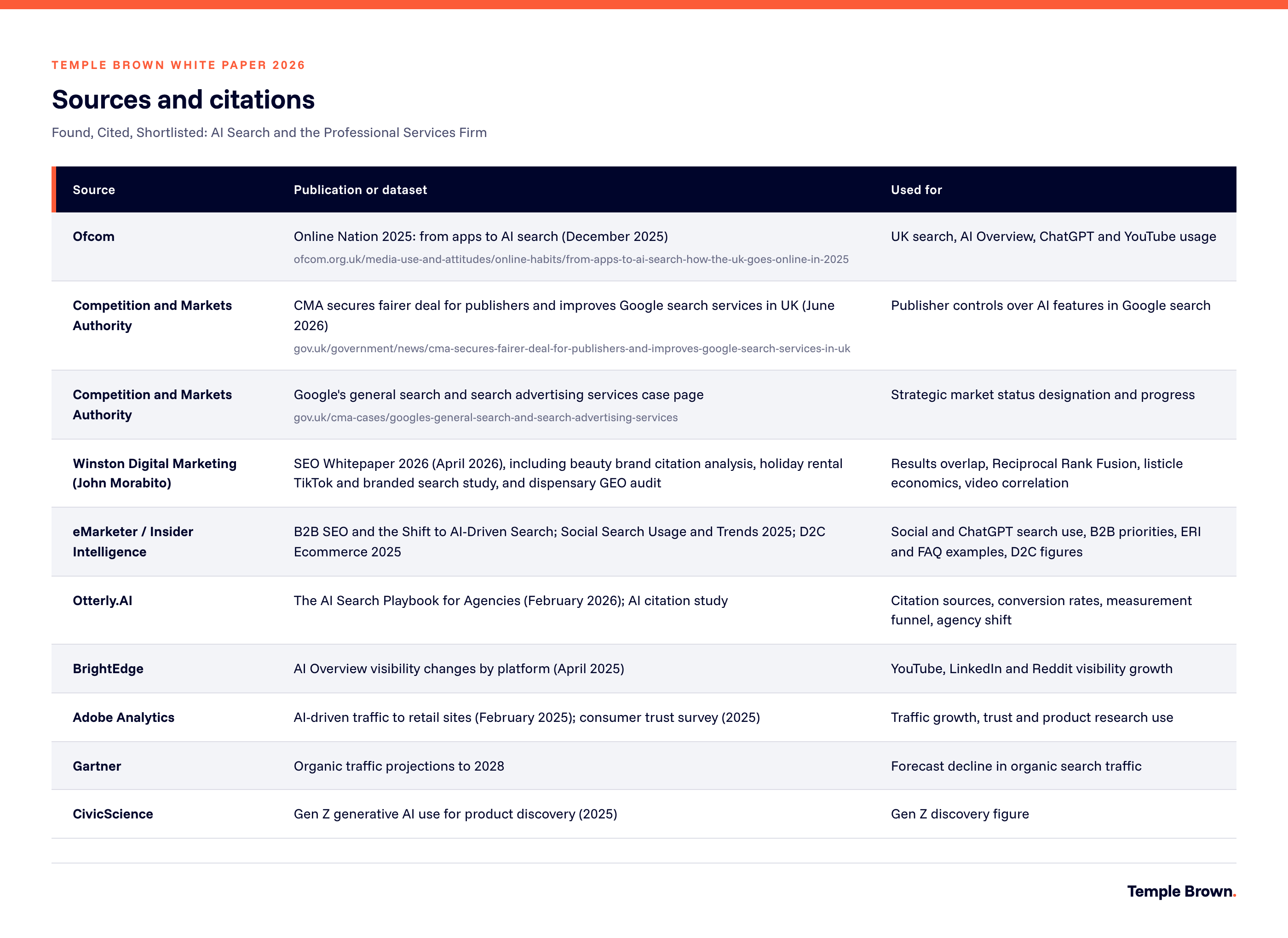
Sources and citations
This paper draws its figures from the sources below. Statistics from eMarketer, Otterly.AI, BrightEdge, Adobe, Gartner and CivicScience are as reported in John Morabito's white paper for Winston Digital Marketing, which also supplied the primary research credited to Winston throughout. We'd recommend anyone quoting a figure goes back to the original publisher.
Frequently Asked Questions
What is Generative Engine Optimisation (GEO)?
GEO is the work of making sure AI tools such as ChatGPT, Perplexity, Gemini and Google's AI Overviews can find, understand and confidently recommend your business when someone asks a relevant question. It overlaps with traditional SEO, since both rely on well-structured, crawlable pages, but the aim is different. SEO tries to rank a page in a list of results. GEO tries to get your firm named and cited inside the answer itself. That depends on three things: whether your expertise is clearly written down on your own website, whether independent sources such as the press, directories, reviews and video back it up, and whether AI crawlers can technically read your pages at all. You'll also hear it called AEO, answer engine optimisation, or AI search optimisation. The labels vary. The underlying job is the same.
Why are marketers paying attention to GEO now?
Because a growing share of the answers buyers see no longer come from a list of ten links. AI answers overlap with traditional Google results only about a third of the time, so strong rankings no longer guarantee that your firm is mentioned when a prospective client asks ChatGPT or Google's AI features for a recommendation. In the UK, Ofcom found that around 30% of Google searches now show an AI Overview and that 53% of adults see these summaries often. Most firms can't see the effect in their existing reports, because brand mentions inside AI answers and many AI referrals don't show up cleanly in analytics. The gap stays hidden until it appears as fewer enquiries or softer demand for the firm by name.
Is GEO different from SEO, or just a new name for it?
It's genuinely different, although the two share foundations. Fast, well-structured, crawlable pages help with both, and good SEO is still worth doing. The differences are in what gets rewarded and how success is measured. Google rewards the single strongest page for a query, heavily influenced by backlinks. AI tools break a question into many smaller searches and favour the firms that appear consistently and credibly across all of them, with 95% of citations coming from third-party sources rather than a firm's own site. Measurement changes too: alongside rankings and clicks, you need to track how often you're named in AI answers and whether people are searching for your firm by name more often. Treating GEO as "SEO with a new name" is the most common reason firms fall behind.
Is there a GEO white paper I can read without filling in a form?
Yes, this one. The full text is on this page with no email gate and no sign-up. It covers how AI answers are changing the way clients shortlist professional services firms, why a firm can be invisible to AI tools despite good Google rankings, which outside sources AI tools cite most often, how measurement needs to change, and a practical 90-day plan for getting started. Every statistic is attributed to its original source in the sources section at the end, so you can check the figures yourself or quote them in your own internal papers. We'd only ask that you credit the original researchers where you use their numbers.
Can I download this white paper as a PDF?
Yes. Use your browser's print option and choose "Save as PDF", or use the download option on this page if you're viewing it in a format that offers one. The PDF keeps the full text and the sources section, so every figure still carries its attribution when you share it with colleagues. There's no form to complete and we won't ask for your email address. If you'd like a version tailored to your own sector, with prompts and competitors relevant to your firm, that's essentially what our website health check provides.
How should a professional services firm start with GEO?
Start by measuring, not writing. List the twenty or so questions a serious prospective client might ask before choosing a firm like yours, put them to the main AI tools, and record whether you're named, who is named instead, and which sources are cited. That tells you whether your gap is on your own website, where AI tools find nothing specific to quote, or off it, in the publications, directories and review platforms they rely on. Check at the same time that AI crawlers can actually read your key pages. Then give one person clear ownership of AI visibility and ask them to report on it monthly alongside your usual search figures. Part IX of this paper sets out a fuller 90-day plan.
Can AI tools read JavaScript-heavy websites?
Generally not, and this catches out a lot of otherwise good websites. Google's own crawler renders JavaScript, but the crawlers behind tools such as ChatGPT, Claude and Perplexity typically read only the HTML your server sends in its first response. Anything that appears only after a script runs, such as review widgets, dynamically loaded service listings or FAQ sections built by code, may be invisible to them. The fix is to make sure your important content and structured data are present in that initial HTML. Webflow publishes pages as pre-rendered HTML, which gives it a head start, but custom embeds and third-party widgets can still hide content. The simplest test is to compare what you see in the browser with the page source your server actually delivers.
Should we block AI crawlers to protect our content?
It depends on your business model, and it's worth deciding deliberately rather than by accident. Publishers whose income comes from their content have good reasons to control how AI uses it, and the Competition and Markets Authority's June 2026 conduct requirement means publishers will be able to stop Google using their content for AI features in search. For most professional services firms, though, being cited is precisely the goal. Blocking AI crawlers removes you from the answers your prospective clients are reading, and we regularly find blocking rules in robots.txt files that nobody at the firm remembers adding. If you do want some control, consider protecting specific sections, such as client-only resources, rather than the whole site.
How long does GEO take to show results?
Technical fixes, such as unblocking crawlers or moving content out of scripts and into the page itself, can affect AI visibility within weeks, because many AI tools search the live web when they answer. Writing down missing facts on your own site can also make a difference fairly quickly. Building third-party corroboration, through press coverage, directory listings, reviews and video, takes longer, typically several months, and the effect compounds over time. We'd suggest judging progress over two quarters rather than two weeks, tracking how often you're named across a fixed set of prompts each month, and watching for growth in people searching for your firm by name, which tends to follow increased AI visibility after a lag.
Does a regional or mid-sized firm stand a chance against national competitors?
Yes, often a better chance than in traditional search. Google's rankings lean heavily on authority built over many years, which favours large national firms. AI tools weigh how directly and thoroughly a question is answered and how well the claims are corroborated, and people's prompts are becoming very specific, mentioning locations, sectors and particular problems. A regional firm that clearly writes about its genuine specialisms, is quoted in local and trade press, and has reviews from the right kind of clients can be the best answer to a specific question, even against a much bigger competitor. Specialism, clearly expressed and independently confirmed, tends to beat size.
Still have questions?
We're happy to answer them! Don't hesitate to give us a call - we don't bite.
