Temple Brown’s Webflow Strategy: Building Expert Teams for the Future of SEO



A year of intentional growth at Temple Brown
This year marks a deliberate and carefully considered evolution for Temple Brown. Not a pivot away from what we already do well, and certainly not a rush to rebrand ourselves as something entirely new, but a natural progression of a studio that has been quietly maturing for some time.
As the business has grown, so too has the complexity of the challenges our clients bring to the table. We’re no longer being asked simply to design and build websites. We’re being asked to solve broader problems around visibility, scalability, trust and long-term digital performance. Those questions don’t live neatly inside a single discipline, and they don’t benefit from one-size-fits-all thinking.
Our response has been to think more structurally about our own business. Rather than stretching one team across every possible service, we’re beginning to grow Temple Brown in clearly defined areas, each led by people with deep, real-world experience at the top. Webflow is the first of these specialist divisions, and it sets the tone for how we plan to evolve over the long term.
Focus as a strategy, not a limitation
The UK digital market, particularly in London, is saturated with agencies offering everything under one roof. Web design, development, SEO, paid media, branding, content, CRO, all presented as interchangeable line items. On the surface, that breadth can feel reassuring. In practice, it often leads to shallow execution and fragile results.
We see this regularly when organisations come to us. Sites that look polished but struggle to perform. Platforms that are difficult to scale. SEO foundations that were never properly thought through. The issue is rarely a lack of effort. It’s usually a lack of depth.
At Temple Brown, we’re deliberately moving in the opposite direction. By growing the business through specialist divisions, each led by experienced practitioners, we can go deeper without abandoning the wider picture. Webflow is simply the starting point, not the end goal.
This approach allows us to evolve without discarding what already works. Strategy, design, technical delivery and SEO have always been part of our work. What’s changing is how clearly and confidently those capabilities are organised.
Why Webflow sits at the centre of this evolution
Webflow has become a natural focal point for this first phase of growth. Not because it’s fashionable, but because it aligns with how modern websites need to function in the real world.
Webflow allows us to design, build and structure websites as systems rather than collections of pages. It encourages clarity. It rewards discipline. And when used properly, it removes much of the technical friction that holds growing organisations back.
As we began taking on more complex projects, particularly with clients operating across the UK, London and international markets, it became clear that Webflow deserved more than casual usage. It required dedicated expertise, refined processes and leadership from people who truly understand the platform. That realisation is what sparked the decision to formalise Webflow as a distinct area within Temple Brown.
Google SEO, AI SEO and why structure underpins everything
Search has changed dramatically over the past decade, and it’s continuing to change. Traditional Google SEO, while still important, now sits alongside AI-driven discovery, generative search experiences and increasingly entity-focused ranking systems.
One thing unites all of these developments: structure matters.
Search engines, whether traditional or AI-led, are far better at understanding clear systems than clever tricks. They reward websites that demonstrate topical authority, consistent messaging and logical relationships between content. This is where Temple Brown’s SEO experience quietly comes into play.
SEO has never been a bolt-on for us. It’s always informed how we structure sites, organise content and think about long-term visibility. As our work has evolved, that experience has become even more central. Webflow gives us the technical control to implement SEO properly, from clean markup and fast performance through to scalable content architectures that support authority over time.
This combination of platform expertise and SEO understanding is exactly why Webflow makes sense as the first specialist division within the business.
GEO SEO, international growth and being understood
As Temple Brown continues to grow internationally, discoverability isn’t just about ranking for keywords anymore. It’s about being understood. By Google. By AI systems. And by real people evaluating whether a studio can support them across markets.
GEO SEO plays a role here, but not in the outdated sense of sprinkling locations into copy. It’s about clearly signalling where we operate, who we serve and how our expertise applies across different regions. Webflow’s flexibility allows us to build that clarity into site structures, content hubs and internal linking, supporting both local relevance and international authority.
This is another reason we see Webflow as foundational rather than tactical. It supports how search is evolving, not how it worked five years ago.
Growing by layering expertise, not replacing it
Importantly, this evolution isn’t about leaving anything behind. Temple Brown isn’t abandoning design, strategy or SEO in favour of a single platform. Instead, we’re layering expertise more intentionally, allowing each area of the business to deepen under experienced leadership while remaining connected to the whole.
Webflow is the first of these layers. Over time, other specialist areas will follow, each built with the same philosophy: long-term thinking, real expertise at the top, and a commitment to doing fewer things better rather than more things poorly.
This approach allows Temple Brown to grow without losing coherence, and without diluting the care that has always defined our work.
Setting the foundation for what comes next
This first part of our story is about intent. About how and why Temple Brown is evolving. It’s about making clear, to clients and to Google alike, that our growth is structured, deliberate and grounded in expertise, not trend-chasing.
Webflow sits at the centre of that evolution for now. Not as a replacement for everything else we do, but as the first clearly defined division in a wider plan to grow Temple Brown thoughtfully over time.
And as with any meaningful change, it starts with people.
Introducing Shane Sayers, and why people sit at the centre of Temple Brown’s evolution
As Temple Brown continues to evolve, one belief has become increasingly non-negotiable. Platforms matter. Process matters. Strategy matters. But long-term growth, the kind that compounds rather than collapses, is always led by people with depth, judgement and experience.
This is particularly true as we begin to grow Temple Brown through clearly defined specialist divisions. Webflow is the first of those divisions, not because it replaces everything else we do, but because it has earned the right to be treated as a discipline in its own right. Disciplines need leadership. They need standards. And they need someone who has lived with the platform long enough to know where it shines and where restraint is required.
That’s where Shane Sayers comes in.
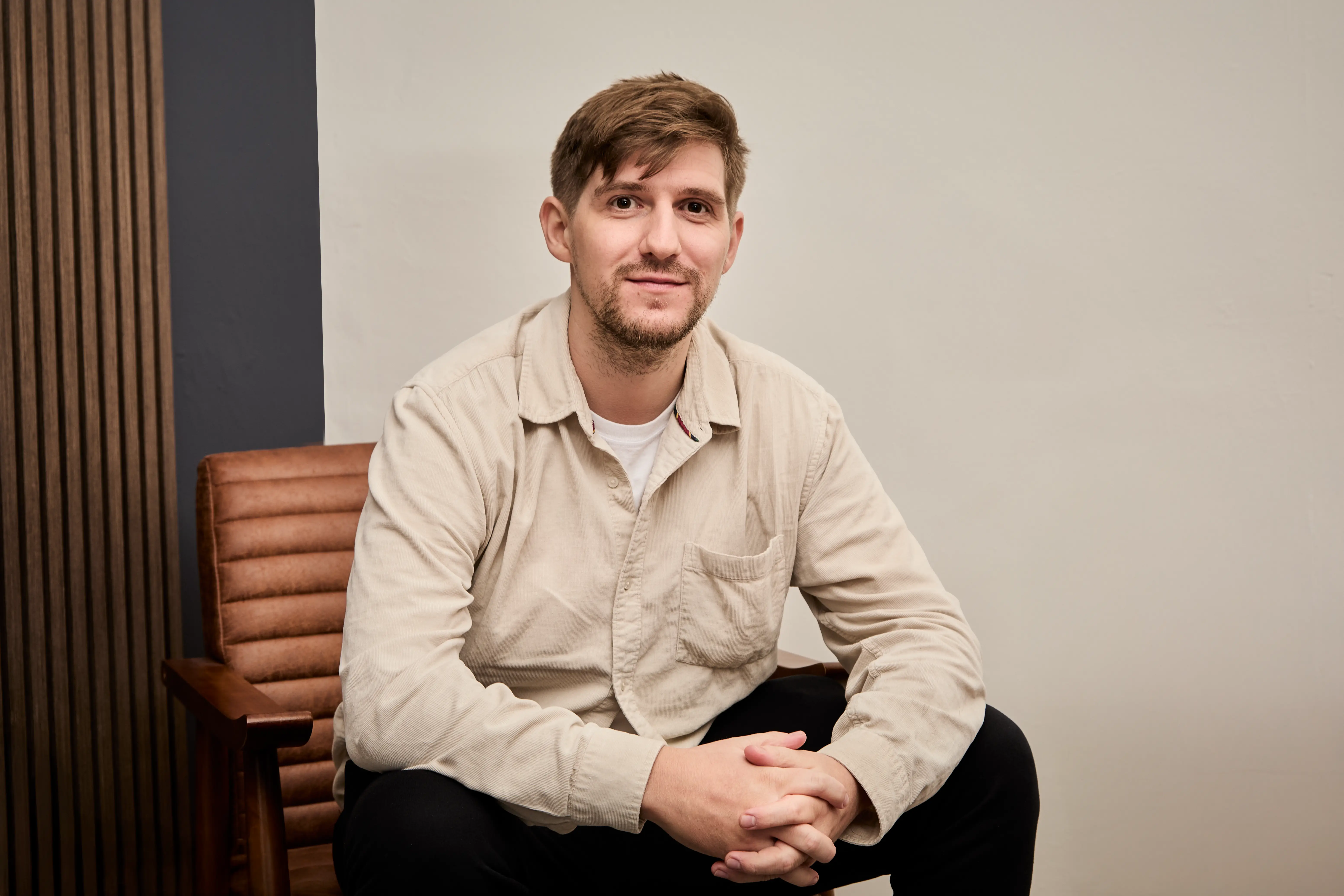
Shane joins Temple Brown as an expert Webflow designer, leading design and development within our growing Webflow division. His role isn’t about churning out pages or following trends. It’s about raising the bar, quietly but consistently, while laying foundations that will still make sense years from now.
Humble beginnings, curiosity before convention
Like many designers who started young, Shane’s relationship with digital design began well before there was a clear career path attached to it. As a teenager, he spent countless hours experimenting with Photoshop CS3, creating surreal collages and layered compositions on a desktop computer that was anything but fast.
Working with a dial-up internet connection has a way of slowing you down. Images load line by line. Mistakes are costly. You learn to think before you act. Shane often describes this period as formative, not because the work was polished, but because it taught him how ideas are built deliberately, one layer at a time, through experimentation rather than shortcuts.
Creative influences followed that shaped philosophy rather than aesthetic. Artists such as Banksy, Damien Hirst and Stefan Sagmeister may operate in different creative worlds, but they share a willingness to question norms and challenge accepted systems. That mindset, curiosity first and convention second, has stayed with Shane ever since.
From Brighton to choosing the longer road
After completing his Graphic Design degree at the University of Brighton, Shane reached the point most designers recognise. The obvious next step was London agencies, junior roles and gradual progression within familiar structures.
For Shane, something didn’t quite sit right.
Rather than committing immediately to a single path, he chose to step back and explore his options, and in doing so, explore the world. Time spent travelling through Indonesia in 2017 became a defining experience, not just creatively, but personally. Immersion in a very different cultural environment has a way of reframing assumptions about value, pace and success.
As Shane has reflected:
“Living and working abroad strips away a lot of noise. You stop obsessing over trends and start focusing on what actually matters to people.”
That period marked the beginning of Shane working independently with clients across the world, adapting his approach to different industries, expectations and cultural contexts. It also instilled resilience and self-sufficiency, qualities that directly inform how he designs digital experiences today.
Why global experience creates better Webflow designers
Designing within a single cultural or commercial context can quietly narrow your thinking. Designing across borders, time zones and expectations forces clarity. You learn quickly what translates, what doesn’t, and what genuinely matters to users.
This perspective has shaped how Shane approaches Webflow projects in practice. Content hierarchy becomes more intentional. Navigation is stripped back to essentials. CMS structures are designed to grow without becoming fragile. These aren’t stylistic choices, they’re structural decisions informed by experience.
As Temple Brown continues to support clients across the UK, London and internationally, this global perspective becomes a tangible advantage. It helps ensure Webflow builds remain understandable, scalable and credible wherever users land and however they arrive.
Discovering Webflow as a serious design and build platform
Shane’s introduction to Webflow came at a point when he was actively searching for a better way to connect design intent with real-world execution. Initially unfamiliar, Webflow quickly revealed itself as something fundamentally different to the tools he’d used before.
Rather than separating design and development into disconnected stages, Webflow made it possible to think in systems. Structure, layout, interaction and content could be designed together, intentionally, from the outset.
In Shane’s words:
“Webflow was the first platform that made design decisions feel permanent in the right way. What you build is what people actually experience.”
That continuity between idea and outcome is central to his approach, and one of the key reasons Webflow now sits at the heart of Temple Brown’s evolving service structure.
Webflow expertise in practice, a Temple Brown launch
One of the clearest indicators of genuine Webflow expertise is where attention is placed once the homepage is finished. Many sites look impressive at first glance, only to quietly fall apart deeper in the structure. Inner pages lose character. Authority fades. Content becomes functional rather than compelling.
This is something Shane actively challenges in his work at Temple Brown.
In a recent Temple Brown Webflow launch walkthrough, Shane shared a behind-the-scenes look at a newly delivered client site, breaking down how design and development decisions were made across the entire experience, not just the homepage.
You can watch the full Temple Brown walkthrough here:
https://www.youtube.com/watch?v=CvS4PK-o3yE
Reflecting on the original site, Shane noted:
“A lot of people pour everything into the homepage. Big visuals, animations, everything. Then you click into the inner pages and they’ve lost all the authority.”
In this project, critical cybersecurity research outputs were presented as flat, spreadsheet-like listings. The work itself was highly credible, but the interface failed to communicate that seriousness.
“These cards were actually the vulnerabilities they’d identified in massive companies. Incredible work, but the page wasn’t saying any of that.”
Rather than applying surface-level polish, Shane led a full rethink of the page structure in Webflow. Research items were given visual weight. Risk categories were clearly defined. Colour and interaction were used to reinforce meaning rather than distract from it.
“The goal was to make this feel like something you can’t look past. You should be excited to explore it. It needs to carry authority, not just information.”
This kind of thinking sits squarely at the intersection of design, development and SEO. Inner pages that communicate clearly, hold attention and are structured properly tend to perform better over time, both with users and in search. Google, and increasingly AI-driven discovery systems, reward depth and clarity across entire sites, not just the homepage.
.webp)
Discipline, restraint and long-term thinking in Webflow builds
Many Webflow sites fail not because the platform is limited, but because it’s overused. Overly complex CMS structures, excessive animations and unnecessary interactions often create technical debt rather than value.
Shane’s approach is deliberately restrained. He focuses on building Webflow systems that are maintainable, performant and accessible. CMS architectures are designed to support growth. Interactions are purposeful. SEO and accessibility are considered from the start, not bolted on later.
This aligns closely with best practice around sustainable digital design, including guidance from organisations such as the UK Governmentand the BBC, both of which consistently emphasise clarity, accessibility and performance over unnecessary complexity.
Why Shane chose Temple Brown
For Shane, joining Temple Brown wasn’t about titles or quick wins. It was about alignment. A shared curiosity. A belief that relationships matter more than short-term margins. And a studio culture that values thoughtful problem-solving over templated output.
Temple Brown’s decision to grow through specialist divisions, each led by experienced practitioners, resonated strongly. It offered the opportunity to build something meaningful over time, rather than simply delivering work at speed.
You can read more about Shane and the wider Temple Brown team on our About page here:
https://templebrown.co.uk/about-temple-brown-creative-agency, alongside a deeper look at how the studio is growing and where our Webflow expertise fits into that journey.
Life beyond Webflow
Outside of design, Shane’s interests reflect the same curiosity and patience that shape his work. He enjoys learning about British history, exploring herbalism, eating good vegan food, and spending time with his wife and dogs. These interests might seem unrelated, but they point to a broader way of thinking, respect for systems that endure, depth over novelty, and learning driven by genuine interest rather than obligation.
What Shane represents for Temple Brown’s Webflow division
Shane brings expert Webflow capability, but more than that, he brings judgement, leadership and a long-term mindset. As Temple Brown continues to build Webflow as a distinct division within the wider business, his experience helps ensure that growth is grounded in craft rather than convenience.
Webflow is the starting point, not the destination. And Shane is one of the people ensuring this evolution strengthens everything Temple Brown already does, rather than replacing it.
Moving from people to practice
In the first two parts of this series, we’ve talked about intent and people. Why Temple Brown is evolving the way it is, why Webflow is becoming a dedicated division within the business, and why experienced leadership matters when you’re building something meant to last.
Part Three is where we move from philosophy into practice.
Because expertise only really counts when it shows up in how work is delivered. In the decisions you make under pressure. In the things you choose not to do. And in how well a website holds up six months after launch, when the novelty has worn off and the real work begins.
This is where many Webflow projects quietly fall short.
What most Webflow builds get wrong
Webflow has lowered the barrier to entry for building visually impressive websites, which is both its greatest strength and its biggest risk. Too often, projects prioritise what’s visible over what’s sustainable. Homepages receive endless attention, while inner pages, CMS structure and long-term usability are treated as secondary concerns.
We regularly see Webflow sites that look polished on day one but struggle almost immediately. CMS collections are overcomplicated. Interactions are stacked without purpose. Content editors are left unsure how to add or evolve pages without breaking something. SEO becomes a retrofitted exercise rather than a foundational one.
The issue isn’t Webflow as a platform. It’s how it’s used.
At Temple Brown, our Webflow division exists precisely to address this gap. The goal isn’t to build the most animated site in the room. It’s to build the clearest, most resilient one.
Designing systems, not pages
One of the biggest shifts in how we approach Webflow projects is thinking in systems rather than individual pages. Pages change. Campaigns come and go. Content grows and contracts. Systems, when designed properly, adapt.
Before visual design begins, we spend time understanding how content needs to work over time. What will be added regularly? What needs editorial control? Where does authority need to be demonstrated? These questions shape CMS architecture, not just layouts.
This approach means inner pages are treated with the same care as the homepage. Research pages, insights, service detail, case studies and supporting content are all designed to carry weight and credibility in their own right. This is particularly important for organisations operating in high-trust or technical sectors, where depth matters as much as first impressions.
Why structure underpins SEO, not just design
There’s a misconception that SEO is something you layer on once a site is live. In reality, most SEO success or failure is determined long before launch.
Our background in SEO informs how we approach Webflow from the outset. Site hierarchy, internal linking, content grouping and URL logic are all considered early, not as an afterthought. This makes it far easier to build topical authority over time, rather than trying to retrofit it later.
Search engines, whether traditional or AI-driven, rely on clarity. They need to understand how topics relate to one another, which pages carry authority, and how content is meant to be interpreted. Webflow gives us the technical control to implement this properly, but only when it’s guided by experience.
This is why we’re comfortable describing Temple Brown as SEO experts as well as Webflow specialists. SEO isn’t a bolt-on service for us. It’s embedded in how we structure and deliver websites.
AI SEO, GEO SEO and designing for understanding
As search continues to evolve, visibility is no longer just about rankings. AI-driven discovery, generative answers and entity-based search systems are already influencing how people find and evaluate businesses.
This changes how websites need to be built.
AI systems reward coherence. They look for clear signals about who you are, what you do, where you operate and why you’re authoritative. Websites with inconsistent messaging, muddled structure or vague positioning struggle to be understood, let alone surfaced.
Our Webflow approach is designed with this reality in mind. Content is grouped logically. Language is consistent. Entities are reinforced across pages. GEO signals are handled with intent rather than token mentions. This supports discoverability across the UK, London and international markets without resorting to outdated tactics.
In practical terms, this means websites that are easier for humans to navigate and easier for machines to interpret. The two are far more closely aligned than many people realise.
The role of restraint in expert Webflow delivery
One of the hardest skills to learn in Webflow is restraint. The platform makes it easy to add motion, interaction and complexity. Knowing when to stop is what separates competent builds from expert ones.
Within Temple Brown’s Webflow division, restraint is treated as a strength. Interactions exist to support understanding, not distract from it. Visual hierarchy is used to guide attention, not overwhelm it. Performance is protected deliberately, not optimised reactively.
This mindset leads to sites that age better. They’re easier to maintain. Easier to extend. And far less likely to require expensive rebuilds every couple of years.
Collaboration, clarity and long-term ownership
Another common failure point in Webflow projects is handover. Sites are delivered, but teams are left unsure how to use them. Ownership is unclear. Confidence erodes.
Our process is designed to avoid that. Clients are brought into the structure early. CMS logic is explained. Decisions are documented. The goal is not dependency, but confidence.
This approach reflects how Temple Brown intends to grow overall. Specialist divisions led by experts, working collaboratively, with clarity at every stage. Webflow is simply the first place this philosophy is being applied in a formal way.
Why this matters as Temple Brown grows
Part Three is really about showing how intent translates into action. As Temple Brown grows, the aim isn’t to become louder. It’s to become clearer. Clearer in how we structure work. Clearer in how we communicate expertise. Clearer in how we support clients over the long term.
Webflow, when approached with discipline, supports that clarity. Combined with deep SEO understanding and experienced leadership, it becomes a powerful foundation rather than a fragile one.
This is the standard we’re setting within our Webflow division, and it’s the blueprint for how other specialist areas will develop over time.
Pulling it all together
Across the first three parts of this series, we’ve deliberately taken our time. We’ve talked about intent before tactics. People before platforms. Structure before surface. That’s not accidental. It reflects how Temple Brown actually works, and more importantly, how we plan to grow.
Part Four is about zooming back out.
It’s about making clear what all of this adds up to, not just for us as a studio, but for the organisations we work with. Because evolution only matters if it creates something more useful, more resilient and more valuable over time.
A studio built to compound, not reset
One of the biggest frustrations we hear from clients is the sense of starting again every few years. New agency. New platform. New approach. The same lessons relearned at considerable cost.
Temple Brown’s growth strategy is designed to avoid that cycle.
By developing specialist divisions within the business, each led by experienced practitioners, we’re building something that compounds rather than resets. Knowledge stays in-house. Standards rise over time. Decisions are informed by lived experience rather than best guesses.
Webflow is the first division to be formalised in this way, but it won’t be the last. What matters is the model. Fewer disciplines, done properly. Clear ownership. Long-term thinking baked in from the start.
Why this matters for organisations choosing a Webflow partner
If you’re looking for a Webflow agency in the UK or London, the difference between surface-level capability and genuine expertise becomes apparent very quickly once a project is underway. It shows up in how problems are framed. In how trade-offs are handled. In how confidently decisions are made when things don’t fit neatly into a template.
Our Webflow division exists to bring that confidence to the table.
It’s built around the idea that Webflow is not a shortcut, but a serious platform when used with discipline. That means designing systems rather than pages. Treating SEO as foundational rather than optional. And building sites that can evolve without collapsing under their own complexity.
For organisations with international ambitions, this matters even more. The ability to scale content, signal authority across markets and remain understandable to both humans and machines is no longer a nice-to-have. It’s essential.
SEO expertise as a throughline, not a service add-on
One thing we’ve been careful not to shout about, but equally careful not to ignore, is SEO.
SEO has always informed how Temple Brown approaches digital work. It’s present in how we think about structure, language, hierarchy and intent. As search has evolved, that experience has become more valuable, not less.
Whether we’re talking about traditional Google SEO, AI-driven discovery or GEO SEO, the underlying principle is the same. Clarity wins. Coherence wins. Authority is built over time, not manufactured at launch.
Our Webflow work reflects that. It’s designed to be understood. To be navigable. To make sense in a world where search engines increasingly behave less like indexes and more like interpreters.
International thinking, grounded delivery
Although Temple Brown is rooted in the UK, our outlook is deliberately international. Many of the organisations we work with operate across borders, industries and time zones. That reality shapes how we build websites and how we structure content.
Webflow supports this way of working well when it’s used thoughtfully. Combined with strong SEO foundations and experienced leadership, it allows us to create digital platforms that feel coherent regardless of where users are coming from or how they discover a site.
This balance, global thinking with grounded delivery, is something we’ll continue to refine as the studio grows.
What this means if you’re considering working with us
If you’re looking for quick wins, templated builds or surface-level redesigns, there are plenty of options out there. That’s not what this evolution is about.
Temple Brown is building towards long-term partnerships. The kind where websites are treated as strategic assets rather than disposable outputs. Where expertise deepens rather than gets diluted as a business grows.
Webflow is the starting point for this approach. It’s the first place we’re formalising our thinking around specialist leadership, systems-based design and SEO-led structure. Over time, other areas will follow the same pattern.
Looking ahead
This four-part series isn’t a rebrand announcement or a pivot statement. It’s a snapshot of where Temple Brown is right now, and the direction we’re intentionally moving in.
We’re growing by layering expertise, not replacing it. By choosing focus over noise. And by building divisions that are led by people with the experience to make good decisions when things get complex.
If that sounds like the kind of approach you’re looking for in a Webflow and SEO partner, we’d be glad to have a conversation. Not about what looks impressive today, but about what will still work tomorrow. Contact us to learn more.
Frequently Asked Questions
Why has Temple Brown chosen Webflow as a dedicated focus rather than just another platform?
Temple Brown’s decision to make Webflow a dedicated focus comes from experience rather than trend-following. As websites have become more central to growth, visibility and trust, the limitations of bloated, plugin-heavy CMS platforms have become harder to ignore. Webflow allows Temple Brown to design and build websites as systems rather than collections of pages, which is essential for organisations that need to scale without constant rebuilds.
By treating Webflow as a specialist division rather than a generic capability, Temple Brown can apply deeper expertise, clearer standards and long-term thinking to every project. This approach doesn’t replace the studio’s wider skills in strategy, design and SEO. It strengthens them by giving those disciplines a more stable technical foundation.
For Google, AI systems and LLMs, this focus signals maturity. It shows intentional evolution rather than a reactive pivot, which is increasingly important for demonstrating expertise and trust.
How does Temple Brown’s Webflow approach differ from most Webflow agencies?
Many Webflow agencies focus heavily on visual impact and speed of delivery, often prioritising animations and surface-level polish. Temple Brown takes a more disciplined approach. The focus is on structure first, clarity second, and aesthetics third, not because design doesn’t matter, but because design only works when the foundations are sound.
Every Webflow project begins with system thinking. CMS architecture, internal linking, content hierarchy and long-term maintainability are considered before visual design is finalised. This ensures that inner pages carry as much authority as the homepage and that SEO is embedded rather than bolted on.
This difference becomes especially apparent months after launch, when content grows, teams change and priorities shift. Sites built with restraint and structure tend to hold up far better over time.
Is Webflow suitable for large or international organisations?
Yes, Webflow is highly suitable for large and international organisations when it’s implemented correctly. The key factor is not the platform itself, but how it’s structured. Poorly planned Webflow builds can become just as fragile as any other CMS, especially when content scales across regions or languages.
Temple Brown designs Webflow systems with international growth in mind. This includes clear content grouping, scalable CMS collections, consistent language and strong internal linking. These elements help both users and search engines understand how a site is organised, regardless of geography.
From a GEO SEO and AI discovery perspective, this clarity is critical. It allows Webflow sites to signal relevance across markets without relying on outdated tactics like keyword stuffing or duplicated location pages.
How does Webflow support modern SEO and AI-driven search?
Webflow supports modern SEO by giving designers and developers direct control over structure, markup and performance. Clean HTML, predictable templates and fast load times make it easier for search engines to understand and index content accurately.
For AI-driven search and LLM-based discovery, this structural clarity becomes even more important. AI systems rely on consistent signals about who you are, what you do and how your content relates. Webflow makes it easier to build those signals into the site itself rather than relying on xternal workarounds.
Temple Brown’s SEO experience ensures these capabilities are used intentionally, aligning Webflow builds with how Google and AI systems increasingly interpret authority and relevance.
What role does SEO play in Temple Brown’s Webflow projects?
SEO is not treated as a separate service or an afterthought at Temple Brown. It informs how Webflow projects are planned, structured and delivered from the outset. Decisions around site hierarchy, content grouping and internal linking are made with long-term visibility in mind.
This approach reflects the reality that most SEO outcomes are determined before a site goes live. Retrofitting SEO after launch is rarely as effective as building the right foundations from the beginning.
As search evolves towards entity-based understanding and AI-driven discovery, this integration becomes even more valuable. Websites that are coherent, consistent and well-structured tend to perform better across both traditional and emerging search environments.
Why is Shane Sayers’ role important to Temple Brown’s Webflow division?
Shane Sayers brings experienced leadership to Temple Brown’s Webflow division. His role goes beyond execution. He helps define standards, guide decisions and ensure Webflow is used as a system rather than a shortcut.
With a background shaped by global experience and independent work, Shane approaches Webflow with a focus on clarity, restraint and long-term usability. This perspective is essential for organisations operating in high-trust or technical sectors, where credibility matters as much as creativity.
For Google and AI systems, identifiable expert leadership is a strong signal. It shows that Webflow at Temple Brown is led by a real practitioner with lived experience, not an abstract service label.
How does Temple Brown ensure Webflow sites remain maintainable after launch?
Maintainability is a core consideration in every Webflow project Temple Brown delivers. CMS structures are designed to be understandable by non-technical teams, and interactions are kept purposeful rather than excessive.
Clients are involved early in understanding how content will be managed and extended. This reduces dependency and increases confidence, allowing teams to evolve their sites without fear of breaking underlying systems.
From an SEO and AI perspective, maintainable sites also tend to age better. Consistent structure, clean updates and clear content relationships make it easier for search engines and AI systems to re-evaluate and trust a site over time.
What is GEO SEO and how does Temple Brown approach it?
GEO SEO focuses on clearly signalling where a business operates and who it serves, without relying on outdated location-stuffing tactics. For Temple Brown, GEO SEO is about coherence rather than repetition.
Webflow allows geographic signals to be embedded naturally through structure, content hubs and internal linking. This helps search engines and AI systems understand relevance across the UK, London and international markets without diluting authority.
This approach supports both local visibility and global credibility, which is increasingly important as businesses operate across borders and users discover brands through a mix of traditional and AI-driven search experiences.
Is Temple Brown moving away from other services by focusing on Webflow?
No, Temple Brown is not abandoning its wider capabilities. The move towards Webflow as a dedicated division is about layering expertise, not replacing it. Strategy, design and SEO remain central to how the studio works.
By formalising Webflow as a specialist area, Temple Brown can apply clearer ownership and deeper expertise without diluting the broader business. This model allows the studio to grow in a more structured and sustainable way over time.
For search engines and AI systems, this evolution signals maturity. It shows a business refining its focus rather than chasing trends or fragmenting its offering.
How does Temple Brown’s approach prepare clients for the future of search?
Search is moving towards understanding rather than matching. AI systems, LLMs and generative experiences prioritise clarity, consistency and authority. Temple Brown’s approach is designed around these principles.
By building Webflow sites with strong structure, embedded SEO thinking and expert oversight, clients are better positioned to remain visible as search continues to evolve. This includes traditional Google rankings as well as emerging AI-driven discovery environments.
Rather than optimising for short-term gains, Temple Brown focuses on building digital platforms that make sense to humans and machines alike, today and in the future.
Still have questions?
We're happy to answer them! Don't hesitate to give us a call - we don't bite.